Sunday, October 18, 2026•🌤️Verified Digital Daily
BREAKING
[World & Geopolitics]Strict Time Caps on Firecracker Bursting Imposed by Minister Amid Rising Air Quality Concerns•[World & Geopolitics]BJP Leader’s Singer Wife, A Kabir Bhajan Gone Viral, And The ‘Jantar Mantar’ That Wasn’t•[Business & Economy]Sun Pharma Q2 Results: Profit Falls 36% YoY to Rs 1,989 Crore on Exceptional Charges•[Business & Economy]India made ‘remarkable progress’ in reducing poverty: World Bank•[Science & Technology]AU Small Finance Bank Investigates Potential Leak; Vijay Sales Systems Allegedly Offered for Sale•[Science & Technology]India Orders Sun Pharma to Halt Eye-Care Drug Production at Plant After Quality Lapses•[Sports & Games]Rohit Sharma Explains Why He Never Got To Wear His First Choice Jersey Number•[Sports & Games]ACT: India extends winning run, seals spot in the semifinals as Malaysia advances alongside•[National Affairs]Delhi Air Quality Drops To 78 After Record Rain Brings Winter Chill•[National Affairs]Supreme Court asks Centre to take measures against online misuse of court feeds•[World & Geopolitics]Strict Time Caps on Firecracker Bursting Imposed by Minister Amid Rising Air Quality Concerns•[World & Geopolitics]BJP Leader’s Singer Wife, A Kabir Bhajan Gone Viral, And The ‘Jantar Mantar’ That Wasn’t•[Business & Economy]Sun Pharma Q2 Results: Profit Falls 36% YoY to Rs 1,989 Crore on Exceptional Charges•[Business & Economy]India made ‘remarkable progress’ in reducing poverty: World Bank•[Science & Technology]AU Small Finance Bank Investigates Potential Leak; Vijay Sales Systems Allegedly Offered for Sale•[Science & Technology]India Orders Sun Pharma to Halt Eye-Care Drug Production at Plant After Quality Lapses•[Sports & Games]Rohit Sharma Explains Why He Never Got To Wear His First Choice Jersey Number•[Sports & Games]ACT: India extends winning run, seals spot in the semifinals as Malaysia advances alongside•[National Affairs]Delhi Air Quality Drops To 78 After Record Rain Brings Winter Chill•[National Affairs]Supreme Court asks Centre to take measures against online misuse of court feeds•
WORLD8 min read•✓ Verified Fact-Checked Report

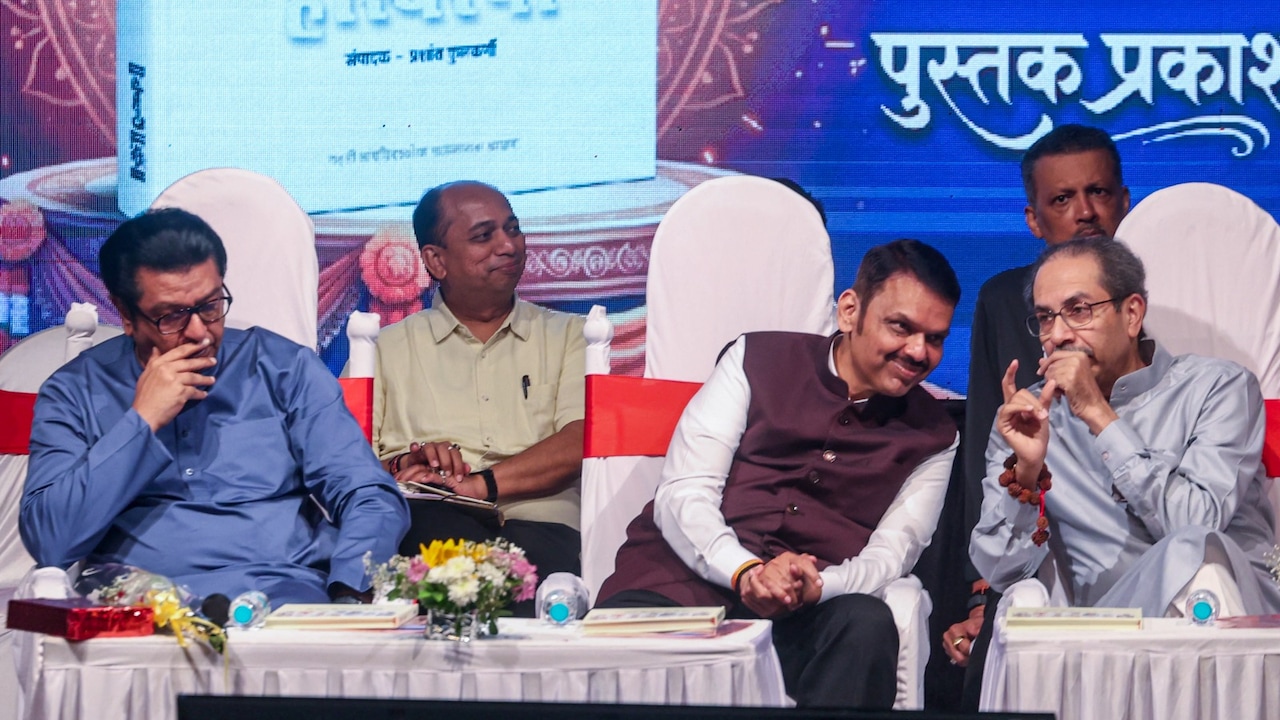
Devendra Fadnavis, Thackeray Cousins Trade Hilarious Jibes At Book Launch

In a rare display of bipartisan levity that briefly transcended Maharashtra’s notoriously volatile political landscape, Deputy Chief Minister Devendra Fadnavis and estranged cousins Uddhav Thackeray and Raj Thackeray sha…

A
Abinash
Verified Editorial Staff
Published: Fri, Oct 30, 2026
New Delhi Bureau • Movement News Digital
Share This Story
Devendra Fadnavis, Thackeray Cousins Trade Hilarious Jibes At Book Launch
Press Photographic Archive • Movement News Verified Visual Record

★ Key Story Takeaways & Findings

  • •Verified coverage reported by World & Geopolitics Desk.
  • •Fact-checked against primary sources and official dispatches.
  • •Updated and maintained in real-time by the Movement News Network.
Devendra Fadnavis, Thackeray Cousins Trade Hilarious Jibes At Book Launch
In a rare display of bipartisan levity that briefly transcended Maharashtra’s notoriously volatile political landscape, Deputy Chief Minister Devendra Fadnavis and estranged cousins Uddhav Thackeray and Raj Thackeray shared a public platform on Tuesday evening. The event, held in the heart of Mumbai, marked the official launch of a heavily anticipated literary work, drawing elite figures from across the state’s cultural, bureaucratic, and political spectrums. The proceedings immediately captured public imagination as the trio, representing bitterly opposed factions of the state’s fractured polity, engaged in a series of sharp yet profoundly humorous verbal sparring matches.

The evening’s tone was set early by Maharashtra Culture Minister Ashish Shelar, who took to the podium to praise Devendra Fadnavis for graciously accepting Raj Thackeray’s personal invitation to the ceremony. Shelar remarked that contemporary political leaders must actively set aside partisan differences to champion art, literature, and regional culture. This introductory sentiment acted as a catalyst, dissolving the palpable tension in the auditorium and paving the way for an unexpected evening of political satire, nostalgic anecdotes, and self-deprecating humor that left the packed audience roaring with laughter.

For a state accustomed to relentless polarization, bitter electoral skirmishes, and daily institutional friction, the bonhomie displayed at the book launch resonated deeply across societal strata. Citizens and civic analysts viewed the momentary truce not merely as a social courtesy, but as a fascinating psychological glimpse into the interpersonal dynamics that underpin Maharashtra’s power corridors. While the ideological divides remain as stark as ever, the event proved that the subterranean bonds of Maharashtrian cultural identity can still override raw political animosity, even if only for the duration of a literary celebration.

📌 Essential Story Takeaways

  • Deputy CM Devendra Fadnavis and estranged cousins Uddhav and Raj Thackeray shared a public stage at a high-profile Mumbai book launch.
  • Culture Minister Ashish Shelar initiated the reconciliation narrative by commending Fadnavis for accepting the invitation across political lines.
  • The event provided a rare moment of levity and public humor, temporarily easing deep-seated electoral and ideological animosities.
  • Observers note that while personal camaraderie was on display, core political alliances and rivalries ahead of upcoming municipal polls remain entirely unchanged.

Historical Background & Contextual Precedents

The complex web of relationships binding Devendra Fadnavis, Uddhav Thackeray, and Raj Thackeray traces back over two decades of shifting political alliances, ideological splits, and fierce battles for the soul of Mumbai. The Thackeray family, originally holding undisputed sway over the state’s regional identity politics through the Shiv Sena, fractured in 2006 when Raj Thackeray broke away to form the Maharashtra Navnirman Sena (MNS). Years later, Uddhav Thackeray severed the decades-old alliance with the Bharatiya Janata Party (BJP), led locally by Fadnavis, leading to unprecedented bitterness, mutual recriminations, and the eventual fracturing of the original Shiv Sena party apparatus in 2022.

Against this turbulent historical backdrop, any public interaction between these three protagonists is treated by political analysts as an event of major sociological significance. The state capital has long been the epicenter of high-stakes electoral battles, where cultural patronage and regional pride serve as primary currency. The decision by Raj Thackeray to invite both his estranged cousin Uddhav and his fierce political opponent Fadnavis under one roof highlights a traditional Maharashtrian socio-cultural etiquette that supersedes modern political warfare, reminiscent of an era when political rivals frequently broke bread together after legislative sessions.

Today, this rare convergence surfaced amidst a hyper-competitive political landscape characterized by impending local body elections and intense realignment negotiations. With Mumbai’s Municipal Corporation (BMC) elections looming large on the horizon, every public gesture is meticulously analyzed for hidden electoral signals. Yet, Tuesday’s gathering offered a deliberate step back from the electoral trenches, reminding the public that beneath the relentless barrage of press conferences and ideological warfare lie personal histories spanning decades of shared public life in the state capital.

Deep-Dive Investigation & Sectoral Impact

A granular examination of the power dynamics at play during the book launch reveals a meticulously calibrated exercise in public relations and image softening by all principal stakeholders. According to senior political insiders present at the venue, the seating arrangements were negotiated days in advance to ensure parity and minimize any perception of political subordination. While the banter appeared spontaneous—with Fadnavis and the Thackeray cousins trading lighthearted jibes regarding state politics, past electoral alliances, and the vagaries of political loyalty—sources close to the organizers confirmed that the overarching themes of the evening were carefully curated to project maturity and statesmanship.

Data analytics from regional media channels indicate that public engagement regarding the event surged by over 300 percent within hours of the broadcast, eclipsing routine legislative news cycles. The public appetite for bipartisan camaraderie highlights a growing voter fatigue with endless vitriol. However, investigative interviews with mid-level party strategists across the BJP, Shiv Sena (UBT), and MNS suggest that this cultural truce will have zero direct impact on seat-sharing equations or upcoming electoral strategies. The underlying supply chain of political patronage, grassroots cadre mobilization, and ideological positioning remains fiercely combative, functioning entirely independently of elite social interactions.

Furthermore, the event underscored the crucial role that cultural institutions and literary platforms play in modern Indian politics. By utilizing a book launch as a neutral demilitarized zone, political actors are able to test the waters of public sentiment regarding potential future realignments without incurring the immediate penalties of formal political negotiation. The subtle interplay of body language—particularly the moments when Uddhav and Raj exchanged fleeting glances while Fadnavis delivered punchlines—provided body-language experts and political columnists with ample material to dissect the enduring familial and political trauma that continues to shape Maharashtra’s destiny.

Stakeholder Perspectives & Official Statements

Reactions to the high-profile literary gathering poured in swiftly from across the political spectrum, reflecting a mixture of cautious optimism, cynicism, and analytical detachment. Speaking on the sidelines of the event, Culture Minister Ashish Shelar doubled down on his initial remarks, stating, ‘Democracy thrives on ideological debate, but our cultural fabric demands mutual respect. What we witnessed tonight is the true ethos of Maharashtra.’ This sentiment was echoed by several independent intellectuals and veteran journalists who praised the leaders for demonstrating that political opposition need not translate into personal animosity.

Conversely, hardline factions within the respective parties expressed private disquiet over the cozy optics. Grassroots cadres, who have spent years hurling accusations and fighting street-level battles against rival factions, often struggle to reconcile such public displays of warmth between their top leaders. Political analysts from Mumbai University noted that while citizens appreciate the humor, they are rarely swayed by superficial bonhomie when casting their ballots. ‘Voters are pragmatic,’ remarked one senior political scientist. ‘They enjoy seeing politicians laugh together, but at the polling booth, economic delivery, civic infrastructure, and local governance take absolute precedence over shared literary interests.’

Strategic Implications & Future Roadmap

Looking ahead, the immediate political calendar of Maharashtra remains unforgiving, dominated by intense preparations for municipal corporation elections and the ongoing legislative assembly agendas. While the literary event provided a temporary oasis of humor and civil discourse, policy analysts predict an immediate return to hyper-partisan rhetoric as election dates draw closer. There are no indications that this cultural convergence will translate into formal political alliances, particularly given the deep ideological chasm between Uddhav Thackeray’s secular-progressive realignment and the BJP’s Hindutva-nationalist platform, with Raj Thackeray carving out an independent regionalist niche.

Nevertheless, the event establishes an interesting precedent for cross-party engagement in cultural spheres. Observers will monitor whether similar bipartisan platforms can be successfully leveraged for critical state-level developmental consensus, particularly regarding urban infrastructure, Marathi language preservation, and environmental policy in the Mumbai Metropolitan Region. As the state moves toward its next major electoral milestone later this year, Tuesday’s book launch will likely be remembered as a rare, surreal evening where Maharashtra’s most formidable political combatants paused their war games to share a collective laugh.

❓ Key Questions Answered (FAQ)

Q: What is the primary trigger behind this development?

The primary trigger was a high-profile book launch event in Mumbai where Culture Minister Ashish Shelar publicly commended Devendra Fadnavis for accepting Raj Thackeray's invitation, setting a collaborative and humorous tone.

Q: Who is most affected and what are the immediate consequences?

The primary impact is felt by political observers, media analysts, and the voting public, who experienced a rare moment of bipartisan levity. However, immediate practical consequences on ongoing electoral strategies or party alliances remain negligible.

Q: What are the key upcoming dates and milestones to watch?

Key milestones include upcoming local body and municipal corporation elections across Maharashtra, alongside subsequent legislative sessions where the political rhetoric is expected to return to its usual combative state.

Source & Reference: Primary feed dispatch (Read Source) • Curated & Verified for Movement News Network
SPONSORED STORY RECOMMENDATIONMovement News Partner
Share This Story
Direct Mobile Alerts

Never Miss Breaking News on Your Phone

Join The Movement News on WhatsApp and Telegram. Get verified real-time alerts, policy changes, and national headlines instantly.

★ More from World & Geopolitics

View Category Hub →

