Sunday, October 18, 2026•🌤️Verified Digital Daily
BREAKING
[World & Geopolitics]Strict Time Caps on Firecracker Bursting Imposed by Minister Amid Rising Air Quality Concerns•[World & Geopolitics]BJP Leader’s Singer Wife, A Kabir Bhajan Gone Viral, And The ‘Jantar Mantar’ That Wasn’t•[Business & Economy]Sun Pharma Q2 Results: Profit Falls 36% YoY to Rs 1,989 Crore on Exceptional Charges•[Business & Economy]India made ‘remarkable progress’ in reducing poverty: World Bank•[Science & Technology]AU Small Finance Bank Investigates Potential Leak; Vijay Sales Systems Allegedly Offered for Sale•[Science & Technology]India Orders Sun Pharma to Halt Eye-Care Drug Production at Plant After Quality Lapses•[Sports & Games]Rohit Sharma Explains Why He Never Got To Wear His First Choice Jersey Number•[Sports & Games]ACT: India extends winning run, seals spot in the semifinals as Malaysia advances alongside•[National Affairs]Delhi Air Quality Drops To 78 After Record Rain Brings Winter Chill•[National Affairs]Supreme Court asks Centre to take measures against online misuse of court feeds•[World & Geopolitics]Strict Time Caps on Firecracker Bursting Imposed by Minister Amid Rising Air Quality Concerns•[World & Geopolitics]BJP Leader’s Singer Wife, A Kabir Bhajan Gone Viral, And The ‘Jantar Mantar’ That Wasn’t•[Business & Economy]Sun Pharma Q2 Results: Profit Falls 36% YoY to Rs 1,989 Crore on Exceptional Charges•[Business & Economy]India made ‘remarkable progress’ in reducing poverty: World Bank•[Science & Technology]AU Small Finance Bank Investigates Potential Leak; Vijay Sales Systems Allegedly Offered for Sale•[Science & Technology]India Orders Sun Pharma to Halt Eye-Care Drug Production at Plant After Quality Lapses•[Sports & Games]Rohit Sharma Explains Why He Never Got To Wear His First Choice Jersey Number•[Sports & Games]ACT: India extends winning run, seals spot in the semifinals as Malaysia advances alongside•[National Affairs]Delhi Air Quality Drops To 78 After Record Rain Brings Winter Chill•[National Affairs]Supreme Court asks Centre to take measures against online misuse of court feeds•
INDIA6 min read•✓ Verified Fact-Checked Report

Students vs Jamia Continues, University Gives Last Warning To Vacate Site

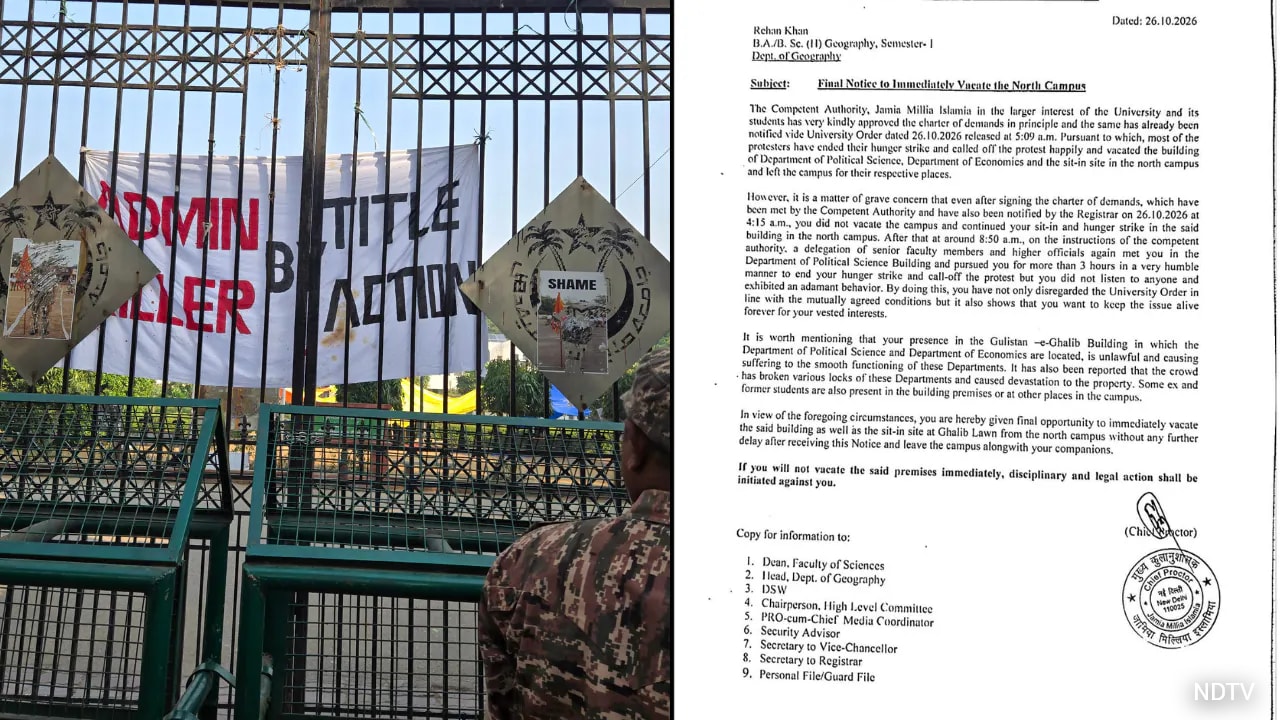
The standoff between the administration of Jamia Millia Islamia and protesting student bodies has escalated sharply, with university authorities issuing an unequivocal final ultimatum directing occupiers to vacate the ad…

A
Abinash
Verified Editorial Staff
Published: Tue, Oct 27, 2026
New Delhi Bureau • Movement News Digital
Share This Story
Students vs Jamia Continues, University Gives Last Warning To Vacate Site
Press Photographic Archive • Movement News Verified Visual Record

★ Key Story Takeaways & Findings

  • •Verified coverage reported by National Affairs Desk.
  • •Fact-checked against primary sources and official dispatches.
  • •Updated and maintained in real-time by the Movement News Network.
Students vs Jamia Continues, University Gives Last Warning To Vacate Site
The standoff between the administration of Jamia Millia Islamia and protesting student bodies has escalated sharply, with university authorities issuing an unequivocal final ultimatum directing occupiers to vacate the administrative enclave immediately. This latest directive marks a critical juncture in a protracted dispute that has paralyzed standard operational workflows across several key academic departments, prompting mounting concern from civil society groups, educational watchdogs, and federal observers over the stability of campus governance.

In a strategic policy shift designed to de-escalate tensions while simultaneously drawing a hard line against prolonged occupation, the university administration has formally revoked a series of contentious disciplinary actions, including prior suspension orders and show-cause notices previously slapped against student activists during the peak of the recent agitation. However, this administrative olive branch has failed to break the deadlock, as student leaders maintain that full institutional concessions—specifically regarding democratic representation and policy reforms—remain unfulfilled, setting the stage for a high-stakes confrontation.

The broader societal impact of this lingering impasse extends far beyond the perimeter walls of the historic institution, igniting nationwide debates concerning the boundaries of student dissent, the militarization of academic spaces, and the delicate equilibrium between institutional authority and constitutional rights to assembly. As federal education ministries monitor the situation with growing apprehension, the coming hours threaten to dictate a new precedent for how prominent central universities manage internal student dissent and administrative enforcement.

📌 Essential Story Takeaways

  • Jamia Millia Islamia administration issues an absolute final warning demanding the immediate clearance of occupied campus sites.
  • The university has revoked all prior suspension orders and show-cause notices issued to student agitators as a good-faith gesture.
  • Protesting student factions reject the conditional olive branch, demanding structural governance reforms and absolute policy reversals.
  • Federal oversight and civil society concern mount as the campus stands on the precipice of potential enforcement actions.

Historical Background & Contextual Precedents

The genesis of the current upheaval traces back to early-semester grievances concerning fee hikes, infrastructural deficits, and the alleged curtailment of independent student bodies within the university ecosystem. Over the preceding months, peaceful demonstrations progressively metastasized into round-the-clock sit-ins, driven by deep-seated frustrations over perceived administrative opacity and the restriction of democratic discourse on campus grounds. Historically, Jamia Millia Islamia has occupied a prominent place in the nation’s socio-political tapestry, often serving as a crucible for intellectual debate and student-led advocacy.

Precedents for such large-scale administrative clampdowns on Indian central universities reveal a recurring cycle of confrontation, wherein institutional imperatives for order frequently clash with the imperatives of student autonomy. The current crisis surfaced with renewed intensity following the sudden implementation of stringent campus security protocols that student representatives characterized as authoritarian overreach. These cumulative grievances transformed isolated departmental protests into a unified, cross-campus movement that has consistently defied successive administrative deadlines, culminating in the current final ultimatum.

Deep-Dive Investigation & Sectoral Impact

A granular examination of the ground reality within Jamia reveals a highly polarized campus ecosystem characterized by restricted access points, heavy security deployment, and an atmosphere of pervasive uncertainty. Investigative interviews with frontline student organizers indicate that the decision to maintain the occupation stems from a profound deficit of trust in verbal administrative assurances. While the university has officially rescinded disciplinary notices on paper, student legal cells argue that these administrative reversals lack statutory permanence, leaving activists vulnerable to targeted retaliation once normal academic schedules resume.

Power dynamics within the institution have grown increasingly volatile, with the administration attempting to isolate hardline factional leaders through direct engagement with moderate student representatives—a strategy that has yielded mixed results. Financial and logistical data from the campus indicate that the protracted agitation has severely disrupted administrative processing, delayed examination schedules, and strained university resources allocated for security management. Supply chains supporting the ongoing sit-in are maintained through coordinated networks of external alumni and sympathetic civil society organizations, insulating the occupiers from immediate resource starvation and fortifying their resolve to hold the ground.

Stakeholder Perspectives & Official Statements

University administration officials have maintained a firm stance, emphasizing that while peaceful expression is protected under institutional statutes, the indefinite occupation of administrative zones violates the rule of law and obstructs the educational rights of the broader student body. In an official briefing, a senior university spokesperson stressed that the revocation of suspensions was executed in an ultimate spirit of academic magnanimity, warning that failure to comply with the final vacation notice would necessitate the invocation of standard institutional protocols to restore order.

Conversely, student union representatives and allied legal defense committees have condemned the final warning as an authoritarian attempt to silence legitimate dissent. Prominent civil rights advocates and academic unions have issued joint statements urging the administration to re-enter unconditional mediation, arguing that punitive ultimatums only serve to exacerbate alienation and deepen institutional fractures. Educational analysts interviewed for this report suggest that the administration’s dual approach of offering concessions while issuing ultimatums reflects a fractured internal consensus among the university’s Board of Management regarding how to handle the crisis without triggering catastrophic public backlash.

Strategic Implications & Future Roadmap

Looking ahead, the immediate trajectory of the Jamia Millia Islamia crisis hinges upon the response of the student collective to the administration’s final deadline. Should the occupiers refuse to vacate the site, institutional analysts project a high probability of administrative enforcement, potentially involving campus security interventions or legal injunctions to clear the area, which risks sparking wider civil unrest. Conversely, a breakthrough negotiation could establish a pioneering framework for student-administration dialogue across central universities nationwide.

Critical dates to monitor include the expiration of the final vacation notice, subsequent emergency meetings of the Academic Council, and potential interventions by the High Court should legal petitions be filed by student defense coalitions. The long-term economic and academic reputation of the institution remains tightly tethered to a peaceful resolution, with stakeholders watching closely to see whether institutional flexibility can triumph over entrenched polarization.

❓ Key Questions Answered (FAQ)

Q: What is the primary trigger behind this development?

The primary trigger is the ongoing standoff between student occupiers and the university administration over governance reforms, fee structures, and the administration's refusal to concede to core demands following months of agitation.

Q: Who is most affected and what are the immediate consequences?

The thousands of enrolled students whose academic schedules and administrative processing are delayed bear the immediate brunt, alongside the university administration facing reputational and operational friction.

Q: What are the key upcoming dates and milestones to watch?

The critical milestones include the precise expiration of the university's final vacation deadline, upcoming emergency meetings of the Academic Council, and any potential legal filings in the High Court.

Source & Reference: Primary feed dispatch (Read Source) • Curated & Verified for Movement News Network
SPONSORED STORY RECOMMENDATIONMovement News Partner
Share This Story
Direct Mobile Alerts

Never Miss Breaking News on Your Phone

Join The Movement News on WhatsApp and Telegram. Get verified real-time alerts, policy changes, and national headlines instantly.

★ More from National Affairs

View Category Hub →
ADVERTISEMENTMovement News Partner
