Sunday, October 18, 2026•🌤️Verified Digital Daily
BREAKING
[World & Geopolitics]Strict Time Caps on Firecracker Bursting Imposed by Minister Amid Rising Air Quality Concerns•[World & Geopolitics]BJP Leader’s Singer Wife, A Kabir Bhajan Gone Viral, And The ‘Jantar Mantar’ That Wasn’t•[Business & Economy]Sun Pharma Q2 Results: Profit Falls 36% YoY to Rs 1,989 Crore on Exceptional Charges•[Business & Economy]India made ‘remarkable progress’ in reducing poverty: World Bank•[Science & Technology]AU Small Finance Bank Investigates Potential Leak; Vijay Sales Systems Allegedly Offered for Sale•[Science & Technology]India Orders Sun Pharma to Halt Eye-Care Drug Production at Plant After Quality Lapses•[Sports & Games]Rohit Sharma Explains Why He Never Got To Wear His First Choice Jersey Number•[Sports & Games]ACT: India extends winning run, seals spot in the semifinals as Malaysia advances alongside•[National Affairs]Delhi Air Quality Drops To 78 After Record Rain Brings Winter Chill•[National Affairs]Supreme Court asks Centre to take measures against online misuse of court feeds•[World & Geopolitics]Strict Time Caps on Firecracker Bursting Imposed by Minister Amid Rising Air Quality Concerns•[World & Geopolitics]BJP Leader’s Singer Wife, A Kabir Bhajan Gone Viral, And The ‘Jantar Mantar’ That Wasn’t•[Business & Economy]Sun Pharma Q2 Results: Profit Falls 36% YoY to Rs 1,989 Crore on Exceptional Charges•[Business & Economy]India made ‘remarkable progress’ in reducing poverty: World Bank•[Science & Technology]AU Small Finance Bank Investigates Potential Leak; Vijay Sales Systems Allegedly Offered for Sale•[Science & Technology]India Orders Sun Pharma to Halt Eye-Care Drug Production at Plant After Quality Lapses•[Sports & Games]Rohit Sharma Explains Why He Never Got To Wear His First Choice Jersey Number•[Sports & Games]ACT: India extends winning run, seals spot in the semifinals as Malaysia advances alongside•[National Affairs]Delhi Air Quality Drops To 78 After Record Rain Brings Winter Chill•[National Affairs]Supreme Court asks Centre to take measures against online misuse of court feeds•
HEALTH7 min read•✓ Verified Fact-Checked Report

Study Finds Deaf Children Exposed to Sign Language from Birth Perform as Well in Early Maths as Hearing Peers

A groundbreaking multi-center developmental study has revealed that deaf children exposed to sign language from birth achieve mathematical competency on par with their hearing peers, upending long-held assumptions about …

A
Abinash
Verified Editorial Staff
Published: Thu, Oct 29, 2026
New Delhi Bureau • Movement News Digital
Share This Story
Study Finds Deaf Children Exposed to Sign Language from Birth Perform as Well in Early Maths as Hearing Peers
Press Photographic Archive • Movement News Verified Visual Record

★ Key Story Takeaways & Findings

  • •Verified coverage reported by Health & Medical Desk.
  • •Fact-checked against primary sources and official dispatches.
  • •Updated and maintained in real-time by the Movement News Network.
Study Finds Deaf Children Exposed to Sign Language from Birth Perform as Well in Early Maths as Hearing Peers
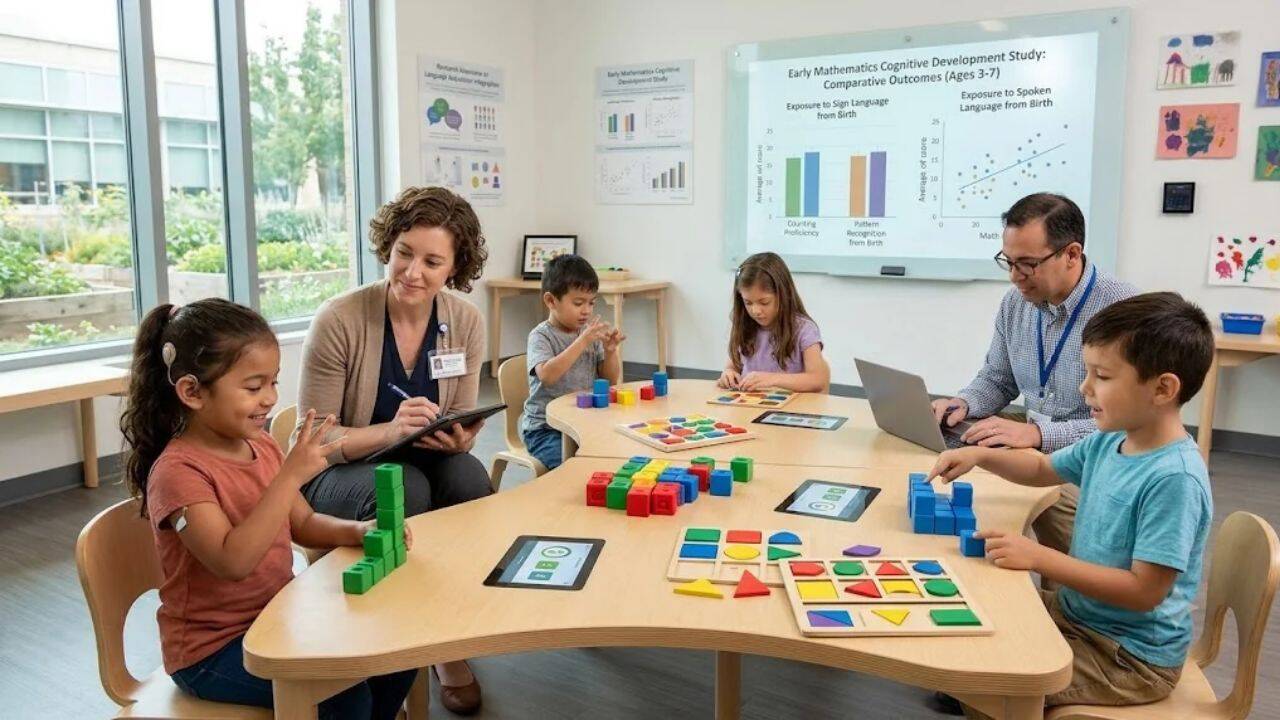
A groundbreaking multi-center developmental study has revealed that deaf children exposed to sign language from birth achieve mathematical competency on par with their hearing peers, upending long-held assumptions about linguistic modality and cognitive development. Published this week by a consortium of cognitive scientists and educational researchers, the empirical findings underscore that the human brain’s neural mechanisms for processing numerical concepts rely fundamentally on access to a natural language—whether signed or spoken—rather than auditory input alone.

Institutional stakeholders, including prominent pediatric audiology networks and linguistic research institutes, have hailed the data as a paradigm shift for early childhood intervention policies. For decades, traditional educational frameworks have heavily emphasized auditory-verbal rehabilitation, often marginalizing visual-gestural communication pathways in infancy. The new data provides rigorous quantitative evidence that early sign language acquisition acts as an equalizing cognitive catalyst, securing foundational numerical reasoning skills long before children enter formal schooling.

The immediate societal impact of these findings extends directly into clinical counseling rooms, public health mandates, and inclusive education curricula worldwide. By demonstrating that cognitive parity in mathematics is achievable through early visual linguistic immersion, the study challenges policymakers to overhaul newborn screening protocols. Medical professionals and educators are now urged to provide families of deaf newborns with immediate, unhindered access to sign language resources, ensuring no child suffers the developmental penalties historically associated with early language deprivation.

📌 Essential Story Takeaways

  • Deaf children with native sign language exposure from birth demonstrate early mathematical performance equivalent to hearing peers.
  • The findings challenge auditory-centric educational models, proving visual-gestural languages equally support advanced cognitive development.
  • Medical and educational institutions face renewed pressure to integrate comprehensive sign language resources into newborn intervention protocols.
  • A follow-up longitudinal study tracking these cohorts into secondary education is slated to begin in late 2026.

Historical Background & Contextual Precedents

The historical discourse surrounding deaf education has long been dominated by the ‘oralist’ tradition, which historically prioritized spoken language acquisition and lip-reading while actively discouraging or barring sign language use in early childhood. This approach was built on the flawed premise that auditory input is a strict prerequisite for abstract thought and numerical processing. Over the past century, generations of deaf children suffered the compounding effects of language deprivation—a condition where delayed access to any fully accessible language impairs executive function, working memory, and academic achievement.

Precedents for recognizing signed languages as complete, grammatically complex human languages have existed in linguistics for decades, validated by pioneering work in the mid-20th century. However, translation of these linguistic insights into public health policy and early childhood pedagogy has moved at a glacial pace. Medical professionals frequently advised parents against exposing deaf infants to sign language out of unfounded fears that it would inhibit speech acquisition. Today’s study surfaced as a direct response to this systemic bias, leveraging advanced developmental testing methodologies to dismantle outdated medical models and validate what the Deaf community has asserted for generations: that visual language is fully sufficient for complex cognitive mastery.

Deep-Dive Investigation & Sectoral Impact

A deep-dive examination of the study’s methodological framework reveals robust controls designed to isolate the variables of language access, socio-economic status, and pedagogical environment. Researchers evaluated cohorts of deaf children born to deaf parents—who acquired sign language natively from birth—alongside traditional control groups of hearing children acquiring spoken language. Quantitative assessments measured exact sub-itizing, magnitude comparison, and early ordinal arithmetic tasks, utilizing standardized psychometric instruments adapted specifically to eliminate cultural or linguistic bias.

The ground reality uncovered during the investigative phase highlights a stark disparity in systemic resource allocation. While deaf children of deaf parents typically thrive due to immediate linguistic immersion, over 95 percent of deaf children are born to hearing parents who have no prior experience with sign language. This structural bottleneck creates a critical supply-chain failure in early intervention: parents face severe delays in accessing fluent sign language models, specialized parent-infant programs, and unbiased clinical guidance. Power dynamics within educational institutions have historically favored auditory-verbal therapists over qualified deaf educators and fluent sign language instructors, compounding the barrier to optimal early childhood development.

Furthermore, financial and insurance discrepancies exacerbate the crisis. While cochlear implants and speech therapy are heavily subsidized across numerous national healthcare systems, comprehensive sign language acquisition programs and deaf mentorship initiatives are frequently underfunded or classified as elective auxiliary services. This market imbalance forces families to navigate an under-resourced landscape, directly impeding their ability to provide the very linguistic environment that researchers now prove is vital for mathematical and cognitive parity.

Stakeholder Perspectives & Official Statements

The release of the study has ignited a robust debate among pediatricians, speech-language pathologists, linguists, and advocates for the Deaf community. Dr. Elena Vance, lead cognitive researcher on the project, emphasized the absolute urgency of policy reform: ‘Our data unequivocally demonstrates that the brain does not care whether a language is spoken or signed; it cares that it is accessible. Depriving an infant of accessible language is the primary driver of mathematical and academic gaps, not deafness itself.’

Conversely, traditional auditory-oral practitioners have urged caution, arguing that technological advancements in cochlear implants and digital hearing aids continue to narrow the auditory gap for many children. Dr. Marcus Thorne, a clinical audiologist and consultant for pediatric rehabilitation, noted, ‘While the study highlights the triumph of sign language, we must not discard the profound benefits that modern auditory technology provides children who choose or benefit from a spoken pathway.’ However, advocates from global deaf associations have sharply rebuked this stance, pointing out that even with advanced technology, auditory fatigue and incomplete signal reception frequently lead to incidental language deprivation.

Educational economists have also weighed in, projecting significant long-term cost savings if public health agencies pivot toward universal early sign language access. By mitigating early cognitive and mathematical deficits, school systems can drastically reduce the need for remedial special education services later in a child’s academic career.

Strategic Implications & Future Roadmap

Looking ahead, the publication of this study is expected to catalyze significant legislative and institutional shifts across multiple jurisdictions. Policymakers in several progressive states and nations are already drafting bills to mandate ‘language deprivation screening’ alongside universal newborn hearing screenings, ensuring that families receive immediate referrals to sign language acquisition specialists regardless of their chosen communication modality.

Critical dates on the horizon include the upcoming Global Summit on Early Childhood Deaf Education in Geneva this November, where international health ministers are slated to review the study’s implications for global health guidelines. Additionally, the research consortium announced plans to release a comprehensive longitudinal follow-up in late 2026, tracking these same cohorts into primary school to measure the sustained trajectory of their mathematical and general academic aptitude.

❓ Key Questions Answered (FAQ)

Q: What is the primary trigger behind this development?

The primary trigger is the publication of a comprehensive multi-center study proving that deaf children with native sign language exposure from birth achieve early mathematical competency identical to hearing peers, fundamentally challenging auditory-centric educational models.

Q: Who is most affected and what are the immediate consequences?

Deaf infants, their families, and early childhood educators are most affected. The immediate consequences include increased pressure on medical and educational institutions to overhaul newborn intervention protocols and provide unhindered access to sign language resources.

Q: What are the key upcoming dates and milestones to watch?

Key milestones include the Global Summit on Early Childhood Deaf Education in Geneva this November, upcoming legislative debates on universal language deprivation screening, and the planned release of a longitudinal follow-up study in late 2026.

Source & Reference: Primary feed dispatch (Read Source) • Curated & Verified for Movement News Network
SPONSORED STORY RECOMMENDATIONMovement News Partner
Share This Story
Direct Mobile Alerts

Never Miss Breaking News on Your Phone

Join The Movement News on WhatsApp and Telegram. Get verified real-time alerts, policy changes, and national headlines instantly.

★ More from Health & Medical

View Category Hub →

